

El Ático: Mac Panamá:
Notes on a museum and the city
Our proposal for the new Museum of Contemporary Art of Panama begins from a simple premise: the museum should not be conceived as an object, but as a place within the city.
The site sits between contrasting urban conditions: the fishing community of Boca La Caja, the expanding district of San Francisco, institutional campuses, and large-scale commercial developments. Within this fragmented context, the project establishes a civic locus by prioritizing the ground.
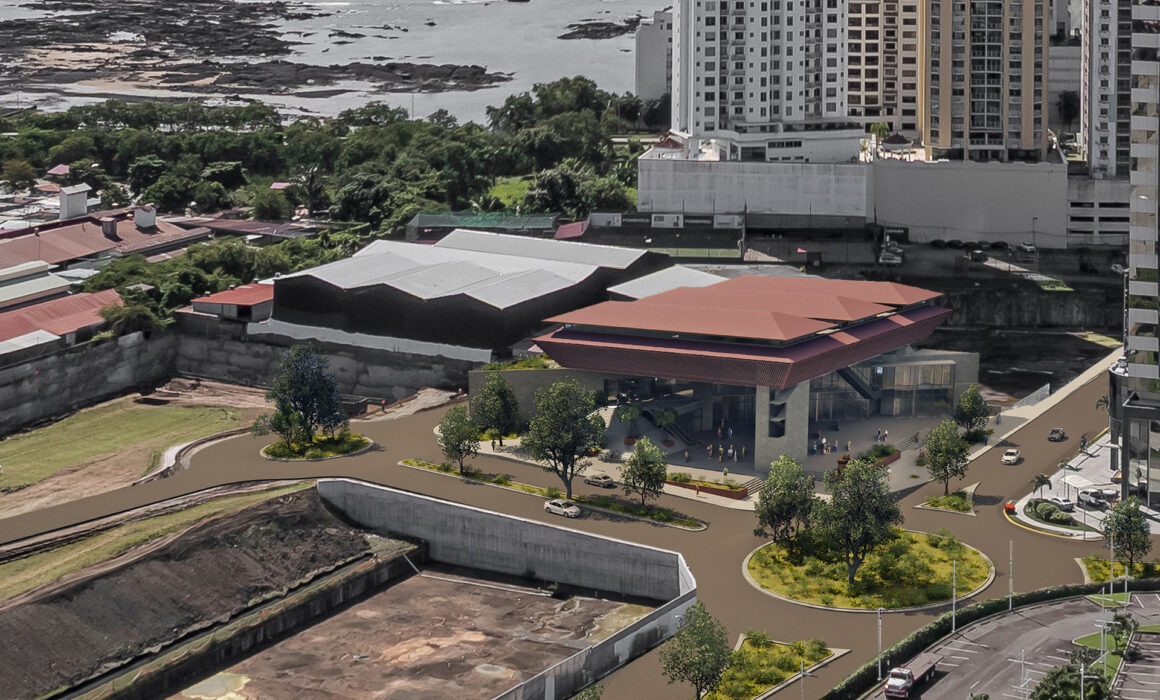
The corner of the lot—its most visible and accessible point—is released as a shaded public space: Atrio Arte, a covered plaza open without a ticket. In the tropical climate of Panama, shade is not an amenity but a precondition for collective life. The plaza is not residual space; it is the primary architectural act. The museum is organized above it.
The project operates through section rather than image. A continuous base—built upon the existing foundation slab—absorbs the technical and service program. Above, a column-free exhibition volume is lifted and defined by indirect zenithal light, wrapped in a permeable terracotta envelope. The separation between both strata allows for cross-ventilation, tempering the public space below.
From the plaza, the building organizes a gradual ascent. Community spaces mediate between the civic ground and the exhibition level, structuring a sequence from the public to the collective, and from the collective to the contemplative.
This stratification is both spatial and institutional. It extends the role of the museum beyond exhibition, positioning it as an active urban platform. In a context increasingly shaped by private development, the project proposes architecture as a means to construct public space.