

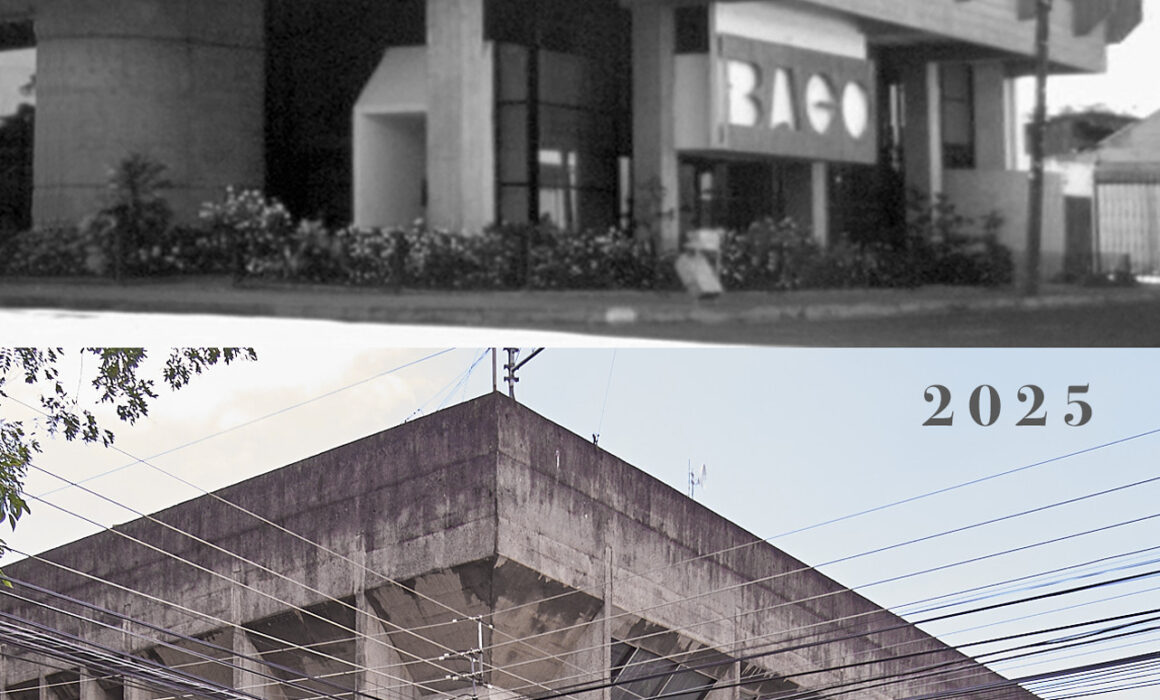
Palacio Municipal de Santa Cruz: Modern Heritage with Community Potential
In 1973, ICESA designed the Banco Anglo Costarricense branch in Santa Cruz, Guanacaste — a corner building that made an immediate urban gesture: the ground floor retreats, extending the sidewalk and casting shade over pedestrians in Guanacaste’s intense climate. Fifty years later, the building stands empty. But its structure still standing, its spatial quality survives, and the question of what it could become is more relevant than ever.
A building that gave back to the street
The design’s primary move was civic. By lifting the active program to the upper floor and freeing the ground level, the building contributed shaded public space to a corner diagonal to Parque Bernabela Ramos. Continuous glazed facades wrapped the recessed ground floor on both street and avenue frontages — open, transparent, accessible. The upper floor inverted this logic entirely: solid exposed concrete, protected by integrated parapets and vertical louvers whose rhythm varied between facades, denser on the south face than the east.
Inside, the material language shifted register. The smooth concrete exterior gave way to thick render and white paint. The double-height main hall was anchored by a suspended mezzanine and a carefully proportioned stair. The upper floor completed an unusual program for a bank branch — residential quarters organized around a central garden courtyard, a typology common to provincial branches of the period built outside the Greater Metropolitan Area.
Three ideas that run through Beer’s work
The Banco Anglo in Santa Cruz belongs to a consistent line of thinking in Franz Beer’s practice. The building emerges from its urban landscape rather than sitting upon it — shade, setback, and public space are architectural decisions, not afterthoughts. Its material contrasts between exterior concrete and interior render, between the solid upper volume and the transparent ground floor, reflect Beer’s sustained interest in tactile-sensory architecture where texture and spatial sequence constitute the experience as much as the plan does. And the interior reveals itself gradually — compressed entry, expanding double height, the surprise of residential quarters above — a spatial concept that rewards the full sequence rather than announcing itself from the street.
From bank to empty building to potential
The Banco Anglo closed in 1994. The building passed to the Municipality of Santa Cruz and has stood vacant since the 2012 Nicoya earthquake. Thirteen years of abandonment have not erased what makes it worth saving: a robust structure, a generous corner presence, and a relationship to the park and the street that few buildings in Santa Cruz can claim.
A recent ICESA post on social media about the building generated an unexpected volume of response — residents proposing uses ranging from a public library to a technology entrepreneurship center to a cultural museum. The conversation revealed something that good architecture tends to produce even after decades of neglect: people recognize it, remember it, and can imagine it alive again.
ICESA has developed a recovery proposal for the building. The civic scale is there. The shaded corner is there. The argument for returning it to public life makes itself.